🚀 The Global Shift: Why Digital Nomad Visas are Crucial
The landscape of work has fundamentally changed, moving from fixed offices to a decentralized, location-independent model. This revolution has been spearheaded by digital nomads—professionals who leverage technology to earn a living while traveling the world. In response, an increasing number of countries are actively welcoming this lucrative talent pool by offering specialized Digital Nomad Visas (DNVs). These aren’t just tourist permits; they are formal residency authorizations that allow you to live and work legally for a foreign employer or run your own business from a host country.
The year 2026 marks a peak in this trend, with more options, clearer regulations, and an increase in competition among nations to attract remote workers. Understanding the nuances of these visas is the first step to a successful nomadic lifestyle.
⚖️ Key Requirements for a Digital Nomad Visa
While the specific rules vary significantly from country to country, most DNV programs share a core set of eligibility criteria designed to ensure the applicant is financially stable and won’t compete with the local labor market.
A. Proof of Remote Work Status
This is the most critical requirement. Applicants must demonstrate they are employed by a company outside the host country or are self-employed with clients based outside the host country.
-
Employment Contract: A formal letter or contract from a non-resident employer confirming your position and remote work status.
-
Business Registration: For freelancers or entrepreneurs, proof of an internationally registered business or a portfolio of foreign clients.
-
Source of Income: Documentation clearly showing that the income is generated from foreign sources.
B. Minimum Monthly Income Threshold
To ensure financial independence and prevent reliance on the host country’s welfare system, every DNV stipulates a minimum monthly income. This figure is frequently tied to the national average wage or a multiple thereof.
| Country Tier | Typical Minimum Income (USD Equivalent) | Notes |
| High Cost of Living (e.g., EU) | $2,500 – $4,000+ | Often requires proof of higher savings or bank balance. |
| Mid-Tier (e.g., Southeast Asia, Balkans) | $1,500 – $3,000 | Lower initial threshold but may increase for dependents. |
| Emerging Markets | $1,000 – $2,000 | May be tied to specific industries like tech or creative arts. |
Pro-Tip: Many countries require applicants to demonstrate an income three to six times the minimum amount for the previous few months to prove consistent earning.
C. Health Insurance Coverage
Comprehensive international health insurance is almost always mandatory. The policy must provide coverage within the host country for the entire duration of the visa. The required minimum coverage amount can range from €30,000 to €50,000.
D. Clean Criminal Record
A police clearance certificate or a background check from your country of residence (and sometimes any country you’ve lived in for the past five years) is required to ensure public safety.
E. Accommodation Proof
Some countries require proof of pre-booked accommodation, such as a rental agreement or a signed lease, covering at least the initial period of stay (e.g., three to six months).
F. Payment of Application Fees
Official government fees for processing the DNV application, which can range from a few hundred dollars to over $1,000, depending on the nation.
🌐 The Top 5 Digital Nomad Visa Destinations in 2026
The DNV landscape is highly competitive. Here are five nations leading the charge, offering excellent infrastructure and attractive visa terms:
1. Portugal 🇵🇹 (D8 Visa)
Portugal remains a gold standard. The country offers the D8 “Digital Nomad” Visa (distinct from the D7 passive income visa), specifically tailored for remote workers.
-
Duration: Initial grant of two years, renewable for three years, leading to permanent residency after five years.
-
Income Requirement: Approximately four times the national minimum wage (around €3,280 per month in 2026, but check the exact current rate).
-
Key Advantage: Access to the EU Schengen Area and a potential pathway to EU citizenship.
2. Spain 🇪🇸 (Digital Nomad Law)
Spain’s dedicated Digital Nomad Law is one of the newest and most comprehensive in Europe, aimed at attracting high-value foreign workers.
-
Duration: One year initially, renewable up to five years.
-
Income Requirement: Around 200% of the national minimum wage (approximately $2,300 per month).
-
Tax Benefit: A significant tax break, allowing nomads to pay a reduced 15% Non-Resident Income Tax for the first four years, compared to the standard progressive Spanish income tax.
3. Barbados 🇧🇧 (Welcome Stamp)
A pioneer in the space, the Barbados Welcome Stamp offers a perfect blend of tropical escape and excellent connectivity.
-
Duration: A straightforward 12-month non-renewable visa.
-
Income Requirement: Must earn a minimum of $50,000 annually (or approximately $4,167 per month).
-
Key Advantage: Simple application process and zero local income tax liability on your foreign earnings.
4. Indonesia 🇮🇩 (Proposed 5-Year Visa)
While a definitive 5-year “Second Home” or “Digital Nomad” visa is still under finalization, Indonesia (especially Bali) is poised to be a major player.
-
Expected Duration: Up to five years.
-
Expected Income/Savings: Likely a high savings requirement (e.g., $100,000 in a local bank account) or a high monthly income threshold to reflect the extended stay.
-
Key Advantage: No local income tax on foreign earnings and access to a vibrant, established nomad community in locations like Canggu and Ubud.
5. Estonia 🇪🇪 (Digital Nomad Visa – DNV)
Estonia’s DNV is unique because it was one of the first specifically designed for remote work. It is an excellent gateway to the European tech scene.
-
-
Duration: Up to one year (365 days).
-
Income Requirement: Minimum gross monthly income of around €3,500.
-
Key Advantage: High-speed internet access, a fully digital government infrastructure, and the option to apply for e-Residency to manage a local EU-based business remotely.
-
💸 Understanding Taxation and Compliance
Taxation is often the most confusing aspect of the digital nomad life. A DNV typically allows you to stay in the host country for more than 183 days, which is the international standard for establishing tax residency. However, DNVs often have specific tax treaties or exemptions.
A. The 183-Day Rule and Tax Residency
Most countries consider you a tax resident if you spend more than 183 days (about six months) in a fiscal year within their borders.
-
Implication: If you become a tax resident, you may be liable to pay income tax on your worldwide earnings to the host country, unless a specific DNV program waives this or limits the liability.
B. Special Tax Regimes
Several countries offer incentives through their DNVs:
-
Zero-Tax Policy: Countries like Barbados and the UAE explicitly state that foreign income earned while on the DNV is exempt from local income tax. This is a massive financial draw.
-
Reduced Rate: Spain’s DNV offers a significantly reduced flat tax rate (e.g., 15%) for the first few years, which is much lower than the progressive scale for standard residents.
-
Non-Habitual Resident (NHR) Status: Programs like Portugal’s (often combined with the D8 or D7 visa) can offer special tax exemptions, though these rules are complex and constantly evolving.
C. Home Country Tax Obligations
Even if you don’t pay tax in the host country, you may still owe tax in your home country (e.g., the United States, United Kingdom, etc.).
-
US Citizens: Must file taxes annually, regardless of where they live. They can often use the Foreign Earned Income Exclusion (FEIE) to exclude a significant portion of their foreign-earned income from US tax.
-
Other Nationals: Should consult their home country’s double taxation treaties to ensure they don’t pay tax on the same income twice.
Crucial Advice: Before applying, consult an international tax specialist familiar with your home country and the target DNV country’s double taxation agreement. Tax compliance is non-negotiable.
🪜 The Digital Nomad Visa Application Process
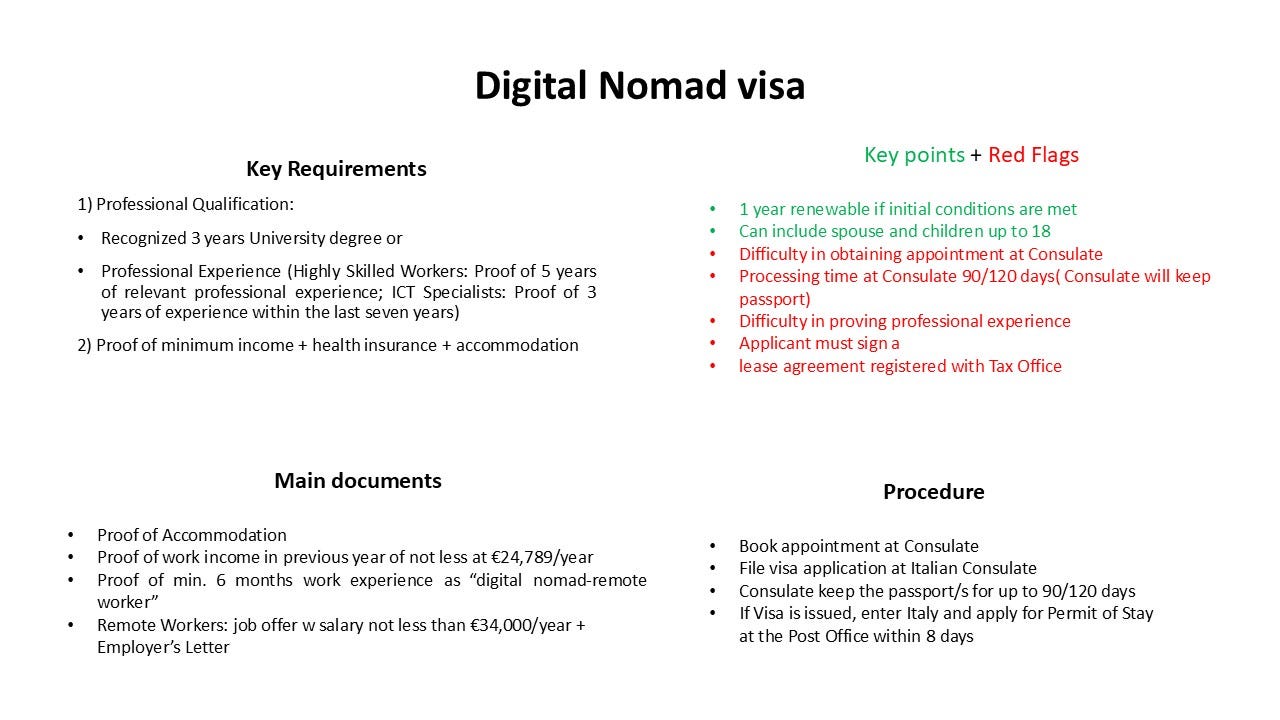
The application is structured, requiring meticulous document preparation and often an in-person interview.
A. Research and Selection
Identify the target country based on your income, lifestyle preference, and the visa’s duration/tax terms. Cross-reference the official government website for the latest 2026 regulations.
B. Document Compilation
Gather all necessary paperwork (as detailed in the ‘Key Requirements’ section). Ensure all documents not in the host country’s official language (e.g., Portuguese, Spanish) are translated by a certified, sworn translator.
C. Submission (Online or Consulate)
Applications can be submitted in two ways:
-
At the Local Embassy/Consulate: The most common method. You apply in your country of origin or legal residence before traveling.
-
In-Country Application (Rare): Some DNVs, like Spain’s, allow you to enter as a tourist and then apply in-country, though this process can be more complex and time-sensitive.
D. Interview and Biometrics
You will typically attend an in-person interview to submit biometrics (fingerprints and photo) and answer questions about your work and financial stability.
E. Visa Issuance and Travel
Once approved, the DNV is issued. You then travel to the host country within the specified timeframe (usually 3 to 6 months) and register with the local authorities to receive your residency card (TIE in Spain, Residence Permit in Portugal, etc.).
📈 Future Outlook: What to Expect in the Digital Nomad Space
The growth of DNVs is not slowing down. In the coming years, expect three major developments:
-
Increased Duration: Many countries are moving from 1-year to 2-year and even 5-year initial grants to attract longer-term “resident-nomads.”
-
Family/Dependent Inclusion: Visas are becoming more accommodating for families, allowing spouses and dependent children to accompany the main applicant easily.
-
New Contenders: More countries in Latin America, Africa, and the Middle East will launch DNV programs, increasing competition and offering unique cultural experiences.
The Digital Nomad Visa is no longer a niche concept; it’s a mainstream immigration policy defining the new era of global mobility. By carefully selecting a program that aligns with your income and lifestyle, 2026 can be the year you truly unlock the world.